
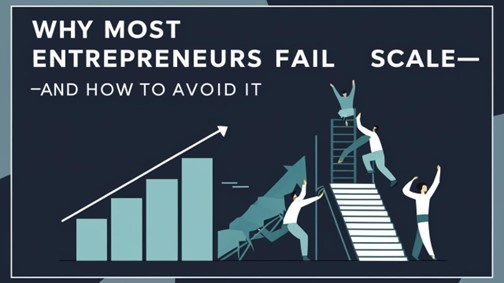
Introduction: The Hidden Challenges Behind Scaling a Business
Launching a business is often celebrated, but sustaining and scaling it is where most entrepreneurs struggle. Beneath the headlines of startup success stories lies a deeper reality—most businesses don’t fail because of bad ideas; they fail because they’re not equipped to scale sustainably.
The early stages are often driven by hustle and ambition. But as the business grows, so do the complexities. Without the right systems, financial planning, team structure, and strategic foresight, even the most promising ventures can plateau.
This article outlines the most common pitfalls founders face while scaling—and shares actionable insights to avoid them.
1. Hustle ≠ Sustainable Growth
In the early stages, founders often wear multiple hats—from sales to operations to customer service. While this is admirable, growth plateaus when systems and delegation are neglected.
Solution:
Focus on building repeatable systems, standard operating procedures (SOPs), and delegation frameworks. Entrepreneurs must transition from “doing everything” to focusing on strategic growth.
2. Lack of a Clear Value Proposition
In saturated markets, being everything to everyone weakens brand identity. Scaling becomes difficult without a compelling value proposition or niche.
Solution:
Identify and serve a specific audience. Articulate what makes your offering unique, and continuously refine based on feedback.
3. Weak Financial Planning
Rapid growth without financial stability is risky. Many startups over-invest or scale prematurely without understanding their financial metrics.
Solution:
Understand unit economics, monitor cash flow, and make data-driven investment decisions. Regular financial projections help build a resilient growth path.
4. Inadequate Team Structure
The team that launches a startup may not always be fit to scale it. Poor hiring decisions or delays in delegation often hinder progress.
Solution:
Build a growth-ready team with clearly defined responsibilities. Focus on culture fit and future-readiness while hiring.
5. Ineffective Marketing and Brand Presence
A great product or service is not enough. If people don’t know about it, growth stalls.
Solution:
Develop a consistent marketing strategy—SEO, paid ads, email nurturing, and personal branding. Thought leadership from the founder can also play a powerful role in brand visibility.
6. Resistance to Change
Clinging to the original idea—even when data suggests otherwise—can limit scalability. Market conditions, consumer preferences, and technology evolve rapidly.
Solution:
Be agile. Listen to your customers, track the market, and pivot when needed. Innovation is not a one-time task; it’s a continuous process.
7. Neglecting Technology and Automation
Manual operations may work for a while, but they’re not scalable.
Solution:
Invest in automation tools—CRM systems, invoicing software, email workflows, and scalable dashboards that streamline business operations.
8. No Long-Term Vision
Without a clear roadmap, short-term wins can distract from sustainable growth. Many entrepreneurs operate without aligning efforts to a long-term vision.
Solution:
Define a 3–5 year vision, set quarterly objectives, and align the team toward shared milestones. Regular strategic reviews keep growth intentional.
9. Compromising Customer Experience
As operations scale, it’s easy to neglect the customer experience. However, growth without retention is unsustainable.
Solution:
Optimize every customer touchpoint—from onboarding to support. Measure satisfaction and loyalty as core metrics.
10. Trying to Do It All Alone
Entrepreneurship can be isolating. Without external perspective, it’s easy to get stuck in operational loops or blind spots.
Solution:
Seek guidance through mentorship, peer networks, or strategic consultants. Learning from others’ experiences accelerates growth and avoids costly mistakes.
Conclusion: Sustainable Scaling Requires Strategy, Not Just Effort
Scaling a business isn’t about doing more—it’s about doing the right things, at the right time, in the right way. Systems, leadership, clarity, and support are critical.
Founders who transition from “operator” to “strategist” are more likely to lead ventures that grow consistently and withstand market shifts.
About the Author:
Varun Surana is a business growth consultant and strategist who helps Indian entrepreneurs build scalable, sustainable, and system-driven ventures. With a track record of empowering startups and SMEs through operational refinement and business modeling, he focuses on creating clarity and growth structures that work.
Looking to scale your venture with expert guidance?
Visit www.varunsurana.in to learn more about personalized consulting programs.